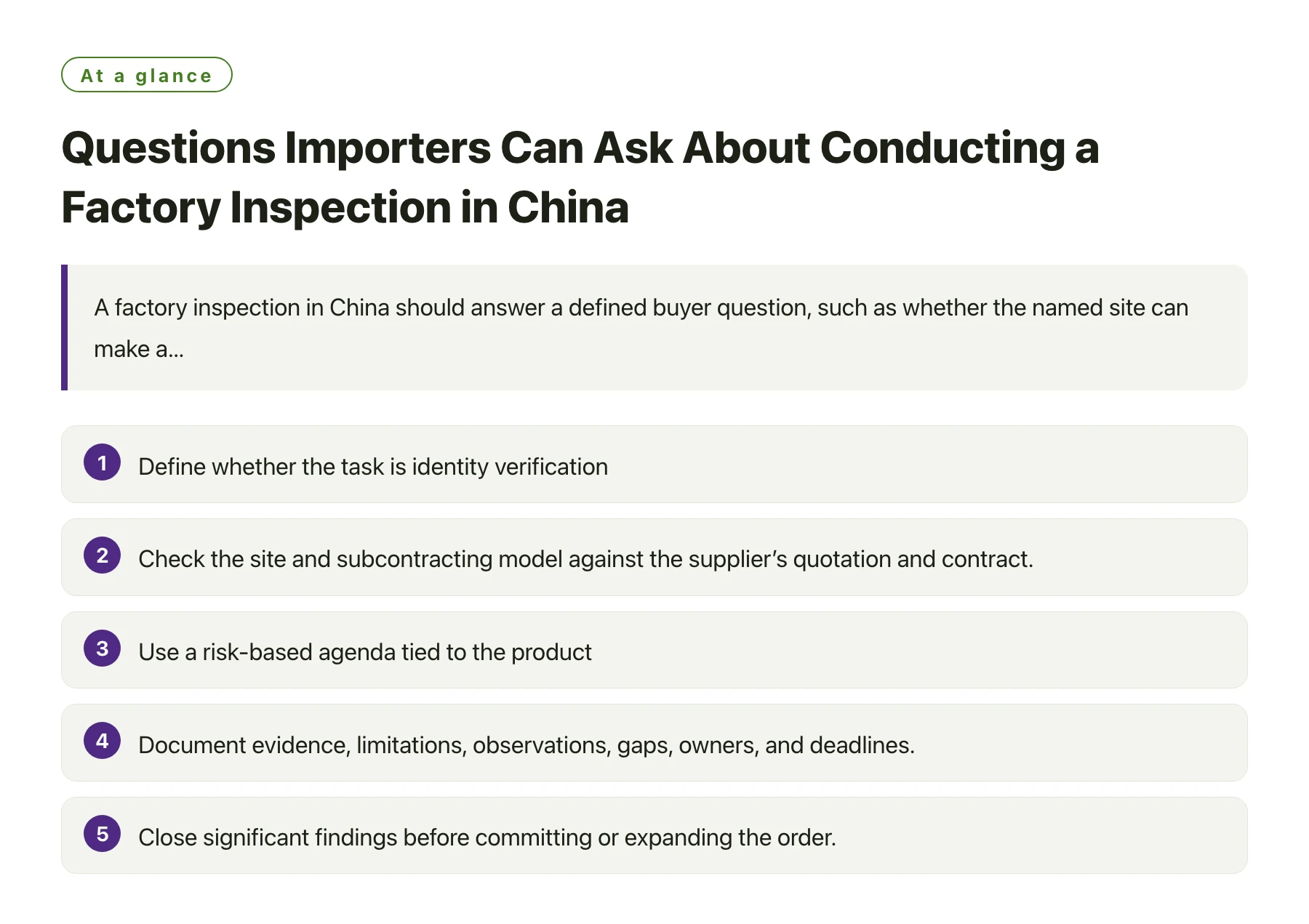
A factory inspection in China should answer a defined buyer question, such as whether the named site can make a particular product at a stated volume under required controls. Before the visit, confirm the contracting entity, factory address, scope, documents, access, safety arrangements, and report format. During the inspection, separate direct observations from supplier explanations and outside-scope questions. Afterward, connect findings to a procurement decision and corrective-action plan.
Key takeaways
- Define whether the task is identity verification, capability review, system audit, or product inspection.
- Check the site and subcontracting model against the supplier’s quotation and contract.
- Use a risk-based agenda tied to the product, volume, schedule, and destination.
- Document evidence, limitations, observations, gaps, owners, and deadlines.
- Close significant findings before committing or expanding the order.
A visit is useful when the scope, evidence, and decision gate are agreed before anyone travels.
1. What decision should the inspection support?
Ask whether the importer needs to verify business identity, manufacturing location, production capacity, quality controls, social or environmental practices, or a specific product requirement. These are different objectives and may require different reviewers. A factory tour can establish observations about accessible areas, but it cannot automatically verify every certificate, labor claim, product test, or future shipment outcome.
ISO 19011:2026 provides guidance for auditing management systems, including audit principles, programmes, and auditor competence. A management-system audit is not the same as a product inspection or a technical assessment of every process. State the type of activity, intended evidence, and exclusions in the visit plan. [1]
2. Is this the site that will make the order?
Compare the legal name, factory address, export entity, quotation, invoice details, and proposed production site. Ask which legal entity contracts with the importer and which facility performs each operation. If the supplier uses subcontractors for finishing, assembly, packaging, or testing, identify them and establish how the supplier maintains traceability and change control.
Record areas the inspector visits, areas not accessible, and explanations provided by site staff. Confirm whether the sample room, warehouse, production line, and quality laboratory belong to the named supplier or another entity. A mismatch should trigger a specific verification question. Do not label a supplier fraudulent solely because a trader, exporter, and factory have different names; establish the relationship with evidence.
3. How should the agenda reflect product risk?
Send a product brief, forecast, destination, required capacity, and known risk list before scheduling. Identify relevant operations such as cutting, molding, machining, coating, assembly, sterilization, or final test according to the product. Ask the factory to show how the process flow, equipment, staff, and controls relate to the offered item rather than following a generic tour route.
Prioritize risks that could affect safety, performance, compliance, delivery, or traceability. Higher-risk orders may justify technical specialists, document review, or an expanded audit. A simple product may need a more limited capability check. Explain the purpose to the supplier and agree who may participate, which records can be photographed, and how confidential information will be handled.
4. What capability evidence should be reviewed?
Ask about production lines, equipment, tooling, maintenance, skilled staff, process steps, current loading, minimum order quantities, raw-material sources, and lead time. Compare claimed capacity with actual shift patterns and orders in progress. Request examples of recent products in the same category and similar volume. Distinguish installed capacity from capacity available to your order during the required period.
Review sample records, process instructions, inspection plans, test equipment, calibration status, nonconformance handling, and corrective actions where relevant. A certificate can support context, but it does not prove the specific product or order conforms. Match records to the site, model, process, and production period, and note any gaps that need follow-up.
5. How should workers, safety, and site conditions be handled?
Confirm visitor registration, site induction, personal protective equipment, emergency procedures, photography rules, and restricted areas. Inspectors should not operate machinery, enter hazardous zones, or interview workers without an agreed safe and appropriate process. If the buyer needs labor-practice or environmental due diligence, define that scope separately and use suitably trained reviewers.
Record direct observations with location, time, and evidence. Distinguish a visible condition from a legal conclusion or allegation. Where an issue could present immediate danger, use the site emergency and stop-work process, notify the responsible contact, and document what action was taken. Do not ask factory staff to conceal a condition or change records during an inspection.
6. Which records and interviews should be checked?
Prepare a document request list tied to the inspection purpose: business details, process maps, production records, equipment maintenance, training, incoming checks, test results, complaints, corrective actions, and subcontractor controls. Choose a sample period and trace selected records from input material to finished product where possible. Record the source, date, model, lot, and who supplied each document.
Ask open questions that let the site explain how work is actually performed. Compare answers with observed practice and records. If a statement cannot be verified during the visit, mark it pending rather than treating it as a confirmed fact. Request follow-up evidence with a named owner and date. Retain only records that the buyer is authorized to access and store under the agreed confidentiality terms.
7. How should findings and limitations be reported?
A useful report includes objective, site, date, attendees, agenda, evidence reviewed, areas observed, limitations, observations, risks, open questions, and recommendations. Separate conforming observations from gaps and unverified claims. For each finding, record requirement or question, evidence, affected process, risk, responsible contact, and due date. Use photos with captions and location or process identifiers.
Avoid a single pass/fail score unless the criteria and score meaning were agreed. State when an area was inaccessible, records were unavailable, or a specialist review is still needed. The report should not imply that a one-day visit guarantees future production quality, legal conformity, or continuous adherence to a management system.
8. What follow-up is needed before an order?
Convert findings into a closure plan. Require a response, evidence, owner, target date, and verification method for each material gap. Decide which issues must close before supplier approval, purchase order, production start, or shipment. If corrective action changes the factory, process, material, or subcontractor, determine whether a follow-up visit or additional product check is warranted.
Keep the approved factory, quotation, product, and order scope linked in the supplier file. Reassess when there is a new site, major process change, repeated defect, capacity expansion, or long lapse since the last review. Buyers seeking JS Sourcing can use an inspection report to guide next steps, while keeping the final supplier and purchase decisions with the importer’s authorized owners.
Sources
Frequently asked questions
Does a factory inspection guarantee that the supplier will deliver conforming goods?
No. It provides evidence about the stated scope and time. Product controls, order-specific inspections, document review, and ongoing performance monitoring may still be needed.
What should an importer prepare before a site visit?
Prepare the purpose, product brief, risk list, supplier identity, document request, attendee roles, safety arrangements, access rules, and report format before booking.
Can one inspection cover multiple subcontractors?
Only if each site and process is explicitly in scope, access is arranged, and qualified reviewers can gather evidence. Identify unvisited subcontractors as open risks.
What is the difference between factory audit and product inspection?
A factory audit reviews defined systems or capabilities; product inspection checks specified goods or samples. State the objective and evidence for each activity separately.