Matching a Mid-Size SUV to a Daily Commute
A commute is the least glamorous way to choose a car and the most accurate. If you drive 42 km a day, five days a week, you cover about 10,080 km a year, and the published WLTP range of up to 525 km for the New G6 turns that into roughly one home charge a week. The numbers that matter are weekly distance, where you can plug in, and how the car behaves in the twenty minutes you spend in it every morning.

Key takeaways
- Work out annual kilometres from daily distance, days a week and weeks a year before comparing anything.
- The New G6 is published with WLTP range up to 525 km and a 10 to 80 per cent charge window of 12 minutes.
- Home charging on Type 2 AC covers a commute; CCS2 DC fast charging covers the longer days.
- Scheduled maintenance stays on a 12-month or 20,000 km interval, whichever comes first.
Work out your distance before you look at cars
Open a map, not a brochure. Measure the door-to-door distance of the trip you make most often and double it, then count the days and multiply by the weeks you actually work. Most people are surprised by the result, because holidays, work-from-home days and school terms cut the total well below the naive estimate.
That single figure decides almost everything else. Below about 15,000 km a year, a mid-size electric SUV with a published range in the 500 km region will spend its life comfortably inside a single weekly home charge. Above 25,000 km a year, the charging hardware and the service schedule start to matter more than the badge on the tailgate.
Write the figure down and take it with you to the dealership. Dealers respond better to a real number than to a vague intention about fuel savings.
What a published WLTP figure does not promise
WLTP range depends on driving style, speed, passengers, load and temperature. A commute in light traffic at moderate speeds sits near the friendly end of that list, while a stop-start crawl in summer heat with the air conditioning working hard sits at the other end.
That is not a reason to distrust the published figure; it is a reason to treat it as a test result and plan margin around it. A commuter who arrives home with 60 km of indicated range every day has a car that fits the routine, and one who arrives with 15 km has bought the wrong spec for the job.
The compensation is the recharge speed. The published 10 to 80 per cent window is 12 minutes on the 5C battery, which is the difference between a commuter car and a car that needs a full evening of planning when the week goes wrong.
The details a commuter checks once and relies on for years
| Item | Published detail | Why a commuter checks it |
|---|---|---|
| WLTP range | Up to 525 km | How often a home charge is needed |
| Rapid charging | 10 to 80 per cent in 12 minutes | Length of an unplanned top-up before work |
| Charger compatibility | Most Type 2 AC and CCS2 DC chargers | Whether the charger near the office works |
| Scheduled maintenance | Every 12 months or 20,000 km | One workshop visit a year for most commuters |
| Remote diagnostics | Standard, and can sometimes resolve issues remotely | Fewer trips across town to a service centre |
Charging between commutes
The home side is straightforward on the published detail. The car is compatible with most Type 2 AC chargers, the flap is on the right rear quarter panel, and the home charging features include plug and charge, anti-theft locking, multi-account sharing and a charging schedule.
Set the schedule to the lowest-cost window your electricity plan offers and let it run overnight. A commuter who charges between eleven at night and six in the morning rarely thinks about charging at all, which is the point.
The public side is for the days the routine breaks: a late meeting, a detour to a client, a school pick-up on the other side of the city. XPENG vehicles are compatible with most CCS2 DC fast chargers, and some Tesla Supercharger sites in Australia are open to non-Tesla vehicles, with the manufacturer's own guidance being to check the Tesla app for site compatibility because not every site supports non-Tesla cars.
Worked example: a 42 km round trip, five days a week
Every number here is an assumption stated plainly, and the only published input is the WLTP range ceiling of up to 525 km for the New G6. Nothing below is a quote or a manufacturer claim about consumption.
Assume a round trip of 42 km, five days a week, for 48 weeks a year to allow for leave and public holidays. Then 42 x 5 = 210 km a week, and 210 x 48 = 10,080 km for the year.
Compare the week with the published range. 210 divided by 525 is 0.4, so the commute asks for roughly 40 per cent of a full published range each week, leaving margin for errands before the next charge.
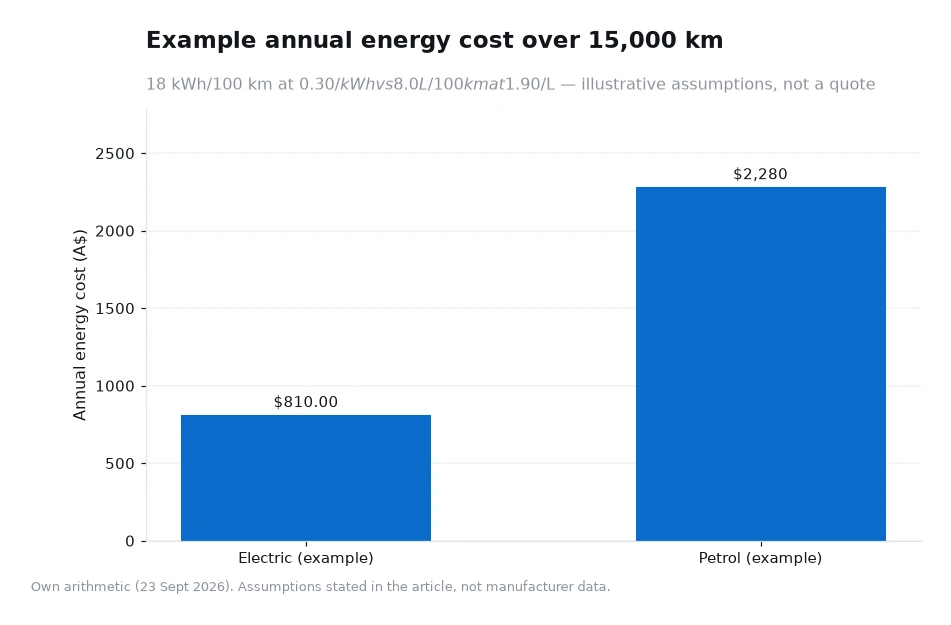
Now put a price on the year, still as an assumption. At 18 kWh per 100 km, 10,080 km divided by 100 gives 100.8 units, and 100.8 x 18 = 1,814.4 kWh. At 30 cents per kWh that is 1,814.4 x 0.30, or about 544 dollars for the year, which is roughly 10.50 dollars a week. For comparison, the chart below uses the same two assumptions over 15,000 km a year: 150 x 18 = 2,700 kWh, and 2,700 x 0.30 = 810 dollars, against a petrol car at 8.0 L per 100 km and 1.90 dollars a litre, where 150 x 8.0 = 1,200 litres and 1,200 x 1.90 = 2,280 dollars.
Service intervals and the working week
One service a year is the normal pattern for a commuter on the published schedule of every 12 months or 20,000 km, whichever comes first. Over five years of commuting at 10,080 km a year, the calendar rule binds: 5 x 10,080 = 50,400 km, and 50,400 divided by 20,000 = 2.52, so distance alone would ask for two visits while the calendar asks for five.
Book the visit in a quiet week rather than the week before Christmas, and use the Owner's App to schedule it. Where a fault appears, remote diagnostics is listed as standard equipment and can sometimes resolve an issue without a workshop visit at all.
If a warning light appears on a Monday morning, the published support path is the XPENG Owner's App and the Authorised Dealer network, with roadside assistance running for 7 years from first registration for the situations that cannot wait.
Frequently asked questions
How much range does a daily commute really need?
A round trip of 42 km a day, five days a week, comes to about 210 km a week, which is well inside the published WLTP range of up to 525 km for the New G6. Because WLTP figures depend on conditions, leave margin for cold mornings, hills and air conditioning.
Is home charging enough for a commuter?
On the published details it usually is. The car is compatible with most Type 2 AC chargers and includes a charging schedule, plug and charge and anti-theft locking, so an overnight charge can cover a normal week with CCS2 DC fast charging kept for the longer days.
What to test in a showroom on a weekday morning
Drive the car at the hour you will actually drive it. Sit in traffic, use the screen with the sun on it, adjust the seat and the mirrors, and check where your coffee cup goes. Then park it in a tight bay and see how the mirrors and the camera line up, because that is the manoeuvre you will repeat more than any other.
Ask for the charging cable arrangement and confirm what comes with the car, since a commuter's plan usually depends on one overnight charge at home rather than a network of public chargers.
The published specification for the mid size electric suv range sits on the manufacturer's Australian pages, and the charging detail is laid out on the site's charging page. Read both before you book a weekday drive through the official Test Drive page.
Range, charging and servicing details in this article come from the manufacturer's Australian site at xpeng.com/au, read on 23 Sept 2026, where WLTP range is stated to depend on driving style, speed, passengers, load and temperature. The 42 km, 48 week, 18 kWh and 30 cent figures are the author's own illustrative assumptions. [1]